Article: How to Measure Ring Size at Home: A Simple, Accurate Guide
How to Measure Ring Size at Home: A Simple, Accurate Guide
Nobody plans their finger measurement around a jewelry emergency. Still, you're probably here at 11 pm, maybe trying to figure out a size without tipping off the person you're buying for. Either way, you don't need a jeweler standing by. A piece of string, a ruler, and about five honest minutes get you most of the way there.
Here's how to actually pull it off, where people quietly mess it up, and what to do once you've got a number you trust.
The Fastest Way: String or Paper
Most people reach for this first, mostly because the supplies are already sitting in a junk drawer somewhere.
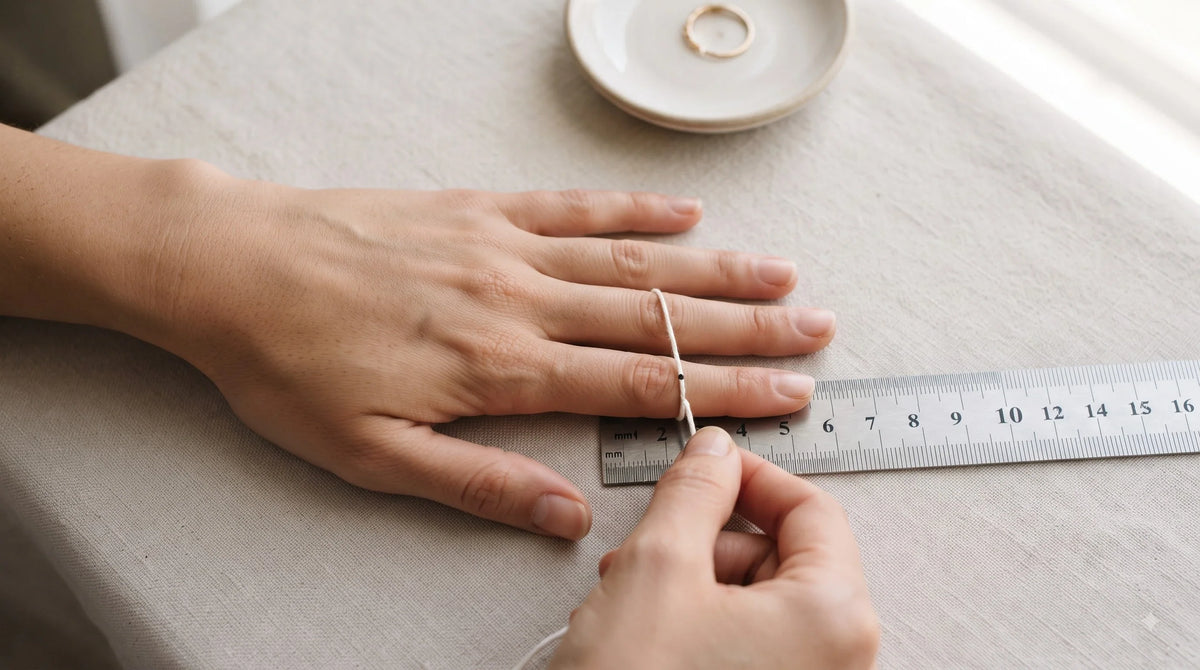
Grab a thin strip of paper or a piece of string that won't stretch. Dental floss works fine; ribbon doesn't, it gives too much under pressure. Wrap it around the base of the finger, right where a ring would actually sit day to day. Snug, not tight. You're aiming for how a ring feels, not how a blood pressure cuff feels.
Mark the exact spot where it overlaps itself. Lay that against a ruler, measure the length in millimeters, and match the number to a standard ring size chart. Done that's your circumference, and circumference is really all a ring size chart is describing.
One tweak that actually matters: do this in the evening, not first thing in the morning. Fingers run a little smaller right after waking up and swell slightly through the day, so an evening reading tells you how the ring will actually feel most of the time you're wearing it not the one time a day your hand is at its smallest.
If You Already Own a Ring That Fits
Genuinely the more reliable route, if you've got something to work with.
Using a ring-size chart: print one with actual-size circles labeled by size, then lay your ring flat on top of each until the inner edge lines up exactly with a printed circle's edge. Land between two sizes? Go up, not down.
Using just a ruler: set the ring flat, measure straight across the inside inner edge to exact opposite inner edge in millimeters. A smaller number to work with, which means less margin for sloppy measuring. A millimeter off here can genuinely bump you a full size.
Using an Adjustable Ring Sizer
Buying rings more than once, or just want something more trustworthy than string? A plastic adjustable sizer costs almost nothing and works like a tiny belt pointed end through the buckle, loop it onto the finger, tighten gradually.
The knuckle is the real test. It should slide over with a bit of resistance, not stick and not glide off freely, and then settle comfortably once past. Wherever the loop meets the buckle at that point is your number.
Where People Quietly Get This Wrong
Four mistakes cause most bad measurements, and every single one is avoidable once you know they exist.
Pulling the string too tight. By far the most common one. A too-tight measurement reads smaller than reality, and the ring you order ends up uncomfortably snug. There's a real, feelable difference between snug and tight trust your instinct here.
Measuring cold fingers. Cold makes fingers contract, sometimes more than you'd expect. Just walked in from winter air? Give your hands a few minutes to warm back up before you start.
Ignoring the bandwidth. A thin stacking ring and a chunky statement band don't wear the same at the same numeric size, even though the tag says otherwise. More metal touching skin equals a snugger feel so if you're eyeing anything past about 10mm wide, size up a half size to compensate.
Measure exactly once. Finger size shifts a little with hydration, temperature, even how much sodium you had at lunch. Measuring two or three times across different moments and comparing results catches the outlier before it becomes a return-and-reorder situation.
US to UK to EU Ring Size Conversion
Ring sizing was never standardized globally, which trips up a lot of first-time international shoppers. The US and Canada run numeric, the UK and Australia run alphabetic, and most of continental Europe just uses a millimeter circumference figure that doesn't map cleanly onto either.
| US Size | UK Size | EU Size | Circumference (mm) |
|---|---|---|---|
| 4 | H | 46.5 | 46.8 |
| 5 | J½ | 49 | 49.3 |
| 6 | L½ | 51.5 | 51.9 |
| 7 | N½ | 54 | 54.4 |
| 8 | P½ | 56.5 | 56.9 |
| 9 | R½ | 59 | 59.5 |
| 10 | T½ | 62 | 62.1 |
| 11 | V½ | 64.5 | 64.6 |
These are close approximations, not exact matches sizing systems weren't built with cross-compatibility in mind. Land between two on the chart, size up, especially for a wider band.
Sizing Someone Else's Finger Without Them Knowing
Surprise proposal, surprise gift either way, you obviously can't just ask.
Best trick going: borrow a ring they already wear on that finger, discreetly, and run it through the chart or ruler method above. Even better if a jeweler can give it an exact read before you return it, quietly, before it's missed.
Nothing to borrow? Ask someone close to them if they happen to know, or fall back on averages roughly 6 to 6.5 for women, 9 to 10 for men and lean on the fact that most jewelers offer free or cheap resizing in the first year. Nobody expects this to be perfect on the first try.
Frequently Asked Questions
What's the best time of day to measure ring size?
Late afternoon or evening fingers have swelled a little by then from normal daily activity. Morning measurements skew slightly small.
How do I know if a ring actually fits well?
It should pass the knuckle with a little resistance, not sliding on freely and not requiring force, then sit comfortably without spinning loose or pinching.
Can every ring be resized later?
Gold, platinum, and silver, generally yes. Titanium, tungsten, and ceramic, generally no the manufacturing process doesn't allow for it. Eternity bands with stones running the whole way around have their own limitations worth asking about upfront.
How accurate is the string-and-ruler method, honestly?
Reasonably accurate for everyday purposes, usually within half a size of a professional measurement, assuming you did it carefully and not with cold hands at 1 am. For something high-stakes, an in-store double-check afterward is still worth the trip.
What if my finger size changes over time?
Totally normal. Weight shifts, temperature, pregnancy, age all of it moves the needle slightly. Most precious-metal rings can be resized by a jeweler, often a size or two in either direction, without touching the setting.
Do wider bands really need a different size?
Yes, genuinely. More surface area touching the finger reads as tighter at the same number, so sizing up a half size past roughly 10mm is a pretty standard call jewelers make automatically.
Getting It Right Matters More Than It Seems
A ring that's slightly too tight turns uncomfortable by the end of a long day. One that's too loose spins, catches on things, or worst case slips off somewhere you'll never find it again. Not a minor detail for something meant to sit on a finger every day for years.
Five minutes with a piece of string now beats a return, a resize, or an awkward moment later. And if the number still feels shaky after trying a couple of these, most jewelers are glad to confirm it in person before anything's locked in.


Leave a comment
This site is protected by hCaptcha and the hCaptcha Privacy Policy and Terms of Service apply.