Article: Types of Engagement Rings: A Complete Guide to Styles, Settings & Designs
Types of Engagement Rings: A Complete Guide to Styles, Settings & Designs
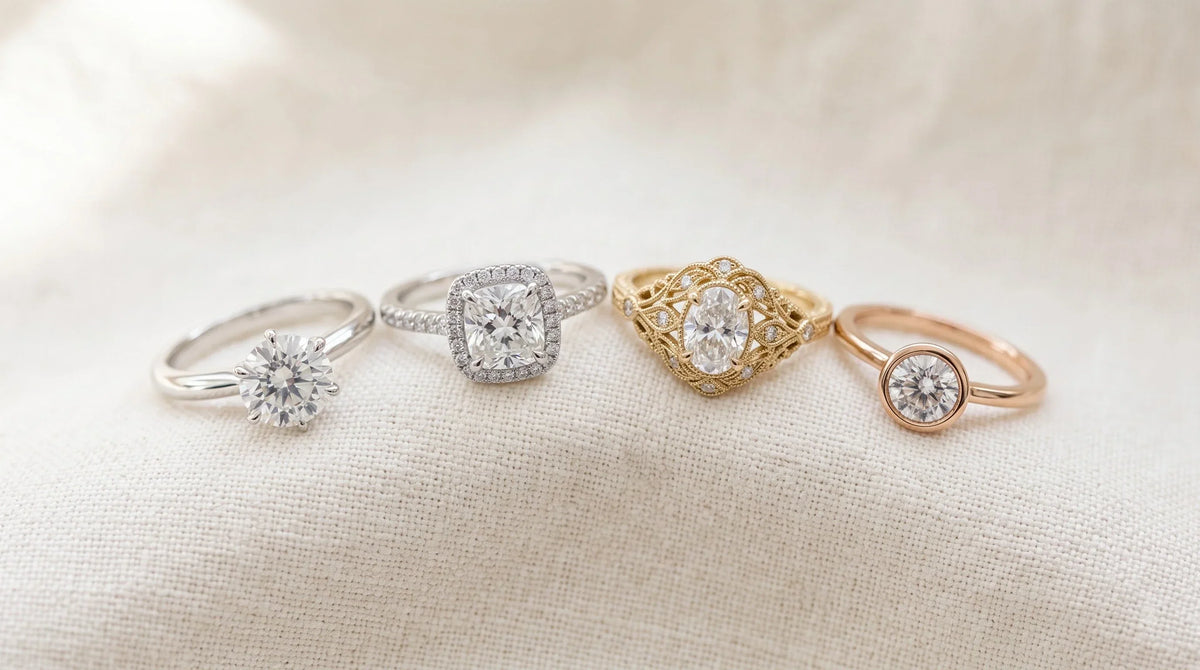
What type of ring should I get? sounds simple until you start looking. Suddenly you're staring at terms like halo, bezel, pavé, cathedral, and half of them sound like they belong to architecture, not jewelry. Part of the confusion is that these words describe two completely different things: how the stone is set, and what shape the stone actually is. Mix those two categories up, and every ring starts to blur together.
So let's untangle it properly. Below is a full breakdown of ring settings, diamond shapes, how they combine, and how to pick between them once you understand the options.
What Are the Different Types of Engagement Rings?
Two separate decisions get bundled into one question here:
-
Ring style or setting: how the center stone is held and how the band is designed. Solitaire, halo, pavé, channel this is the "setting" bucket.
-
Diamond shape or cut: the actual geometry of the stone. Round, oval, emerald, pear this is shape, full stop.
Every ring is really a combination of both. A round diamond can sit in a halo setting or a plain solitaire band. An emerald-cut stone can be bezel-set or channel-flanked. Once that distinction clicks, ring shopping stops feeling like memorizing a glossary and starts feeling like picking two things independently, which is a lot more manageable.
Types of Engagement Rings by Style and Setting
Solitaire
Nothing but the stone. A single diamond sits on a plain band with no supporting cast, which is exactly the point; there's nowhere else for the eye to go. It's the ring most people picture when they hear "engagement ring," partly because it's been the default for so long, and partly because it just works with almost anything, including whatever wedding band eventually sits next to it.
Good fit if you want something that won't look dated in twenty years, or if the diamond itself is the star and doesn't need help.
Halo
Take that same center stone and ring it with a cluster of smaller diamonds. Suddenly it looks bigger than it is, and it throws light from angles a plain solitaire never could. This is the setting most people reach for when they want a "wow, that's a big diamond" reaction without necessarily buying a bigger diamond.
Works well if budget and visual impact are both on the table and you're trying to balance the two.
Three-Stone
A center stone with two side stones flanking it: past, present, future, as the story goes, though plenty of people just like how balanced and full it looks across the finger. It's one of the few styles that carries built-in meaning without anyone having to explain it.
Cluster
Instead of one large diamond, you get several small ones grouped so tightly they read as a single larger stone from a normal viewing distance. It's a clever way to get size and sparkle without the price tag of a big solo diamond; the trade-off is more small settings to maintain over time.
Pavé
French for "paved," and that's literally what it looks like: tiny diamonds set edge-to-edge along the band so there's barely any visible metal between them. It doesn't compete with the center stone; it just adds a continuous shimmer underneath it.
Bezel-Set
A thin rim of metal wraps around the stone's edge instead of prongs holding it from a few points. It's the most protective setting on this list, hands down no exposed edges for a doorframe or gym bar to catch. If the ring needs to survive a job that involves actual hand use, this is usually the first setting worth considering.
Channel-Set
Rather than individual prongs, a row of diamonds sits flush between two metal rails running along the band. No exposed points, nothing sticking up just a smooth line of stones that won't snag on a sweater sleeve.
Vintage and Antique-Inspired
This is where filigree, milgrain (that fine beaded edging along the metal), and older cuts like Asscher or old European cut come in. Some of these rings are literal antiques passed through generations; most "vintage-inspired" pieces sold today are new rings built to look like they've been around for a hundred years. Either way, the appeal is the same: detail and history over clean minimalism.
Hidden-Halo
A halo, but tucked underneath the center stone instead of surrounding its visible edge. Look straight down and it reads as a simple solitaire. Tilt it and there's a hidden burst of extra sparkle you weren't expecting. It's a quiet upgrade for people who want a classic look with a little more going on underneath.
Split-Shank
The band splits into two (sometimes more) strands as it nears the center stone instead of staying one continuous width. It reads as more architectural, more intentional and it often makes the setting area look larger without adding a halo.
Cathedral
Named for the way arched supports lift the stone above the band, similar to cathedral arches. It's a setting built to catch more light by literally raising the diamond higher the trade-off being that anything raised that high is a bit more exposed to snagging than a flush setting.
Tension-Set
The band itself grips the stone through pressure alone no prongs, no bezel. Visually, the diamond looks like it's floating between two metal ends, which is a striking, modern effect. One practical note: because resizing changes the tension holding the stone, this style typically needs a jeweler experienced specifically with tension settings, not just any resizing job.
Popular Diamond Shapes for Engagement Rings
Shape is its own decision, separate from setting, and it changes both how a ring looks and how it wears day to day.
Round is still the default for a reason: it's cut specifically to maximize brilliance, and its symmetry means it photographs and wears consistently well.
Princess cuts are square with sharp corners, offering brilliance close to a round diamond but with a more angular, contemporary outline.
Oval diamonds are elongated, which means they can look larger than a round diamond of the same carat weight simply because more of that weight is spread across visible surface area.
Cushion cuts round off the corners of a square or rectangular shape, landing somewhere between soft and structured a popular compromise for people who can't decide between round and square.
Emerald cuts use long, flat step-cut facets instead of triangular ones, which produces a hall-of-mirrors clarity effect rather than intense sparkle. Worth noting: this cut shows inclusions more readily than brilliant cuts, so clarity grade matters more here than it might elsewhere.
Pear shapes combine a rounded end with a point, like a teardrop. Worn with the point toward the fingertip, it visually elongates the finger.
Marquise cuts are elongated with points on both ends, similar size-stretching effect to oval, plus a distinctly vintage-adjacent silhouette.
Radiant cuts borrow the rectangular or square outline of an emerald cut but trim the corners and add brilliant-style faceting, landing between emerald's geometry and round's sparkle.
Asscher cuts are essentially square emerald cuts with the same step-cut clarity and a more symmetrical outline.
Heart shapes are exactly what they sound like, and they demand precise symmetry to actually look like a heart rather than an uneven blob. Chosen more for sentiment than sparkle.
Engagement Ring Settings Explained
Quick clarification, because "setting" gets used loosely: sometimes it describes the whole ring design (solitaire, halo, three-stone), and sometimes it refers specifically to the mechanism holding the stone in place (prong, bezel, channel, tension). They overlap but aren't identical.
The useful way to think about it: ask what the overall design looks like, then separately ask how the stone is physically secured. A halo ring, for instance, can have prong-set accent stones surrounding a bezel-set center diamond two different "settings" working together in one ring.
How to Choose the Right Engagement Ring Style
There's genuinely no universal right answer here; it comes down to how the wearer lives, what they're drawn to, and what they're comfortable spending.
Lifestyle first. Someone who works with their hands, plays sports, or just moves through a physical day-to-day benefits from a protective bezel or channel setting over anything with high, exposed prongs.
Then personal taste. Clean and modern points toward solitaire, bezel, or tension settings. A love of detail and history points toward vintage-inspired or halo designs instead.
Budget matters more than people admit. Halo and cluster settings are the two best tools for making a ring look bigger and more substantial than the actual carat weight would suggest on its own.
Maintenance is easy to overlook. More small stones means more prongs, which means more eventual trips back to the jeweler for tightening. A solitaire is about as low-maintenance as it gets.
And comfort, which people rarely think about until they're wearing the ring every day. Raised settings like cathedral sit higher and are more noticeable against gloves, keyboards, and daily friction. Flush settings like bezel or channel disappear into the hand much more easily.
Classic, Modern, Vintage, or Minimalist
Classic styles solitaires and simple three-stone rings don't chase trends, so they don't really date either. Modern styles lean into clean geometry: bezel and tension settings, princess or radiant cuts, minimal ornamentation. Vintage brings in filigree and milgrain and cuts you don't see every day, appealing to anyone who wants a ring that feels like it has a story attached. Minimalist strips things back even further: thin bands, simple settings, the stone doing all the talking.
How Metal Choice Changes Everything
The metal isn't just a backdrop it actively changes how the stone reads.
Platinum and white gold run cool and bright, and they tend to make a diamond look especially crisp and white. Yellow gold runs warm, which can cast a slight warm tint against the stone; some people love this for a vintage feel, others avoid it for exactly that reason. Rose gold sits somewhere in between with its pinkish warmth, and it's become a go-to pairing for halo and vintage-style settings especially.
Durability differs too: platinum is denser and holds up better over decades of wear, while gold's durability depends heavily on karat; higher karat gold looks richer but is objectively softer and more prone to scratching.
Types of Engagement Rings: Quick Comparison
|
Ring Style |
Overall Look |
Main Characteristics |
Durability / Protection |
Best Suited For |
|
Solitaire |
Clean, classic |
Single stone, plain band |
Moderate; depends on prong height |
Timeless, versatile buyers |
|
Halo |
Glamorous, fuller |
Ring of accent stones around center |
Moderate; more prongs to maintain |
Bigger look on a budget |
|
Three-Stone |
Balanced, symbolic |
Center stone flanked by two side stones |
Moderate |
Sentimental symbolism |
|
Cluster |
Bold, substantial |
Multiple smaller stones grouped together |
Moderate; many small settings |
Budget-conscious buyers wanting size |
|
Pavé |
Sparkly, detailed |
Small stones set closely along the band |
Moderate many prongs |
Extra shine without a large stone |
|
Bezel-Set |
Sleek, modern |
Metal rim fully/partially encircles stone |
High most protective |
Active lifestyles |
|
Channel-Set |
Smooth, streamlined |
Stones set flush between metal rails |
High |
Low-snag, secure band sparkle |
|
Vintage/Antique |
Ornate, historic |
Filigree, milgrain, unique cuts |
Varies by design |
Detail-lovers, history-minded buyers |
|
Hidden-Halo |
Subtle, elevated |
Halo hidden beneath the center stone |
Moderate |
Classic look with hidden upgrade |
|
Split-Shank |
Architectural |
Band splits into two strands |
Moderate |
Distinctive but not fully vintage |
|
Cathedral |
Elevated, prominent |
Arched supports raise the stone |
Lower more exposed |
Maximum light and prominence |
|
Tension-Set |
Modern, minimal |
Stone held by band pressure alone |
Lower; needs specialist resizing |
Minimalist, modern aesthetics |
Frequently Asked Questions
What is the most popular type of engagement ring?
The solitaire, by a wide margin, mostly because it's timeless and it pairs with literally any wedding band you put next to it later.
What are the main types of engagement ring settings?
Prong (used in solitaire, halo, and three-stone rings), bezel, channel, pavé, and tension. Each one differs in how much of the stone stays exposed versus protected.
What engagement ring style makes a diamond look bigger?
Halo settings, hands down, surrounding the center stone with smaller diamonds, create the illusion of extra size. Cluster settings do something similar by grouping several small stones.
Which engagement ring setting is the most secure?
Bezel-set rings. The metal rim wraps around the stone's edge, so there's simply less exposed surface for anything to catch or chip.
What is the difference between a solitaire and a halo ring?
A solitaire is one stone, a plain band, nothing else. A halo adds a ring of smaller diamonds around that center stone for extra size and sparkle.
Which engagement ring style is best for everyday wear?
Bezel or channel settings. Both minimize exposed edges, which matters a lot more once the ring is going through an actual daily routine instead of sitting in a box.
How do I choose an engagement ring style?
Start with how the wearer actually lives day to day, then layer in personal taste: classic, modern, vintage, minimalist, and budget. Diamond shape is the last piece, chosen to complement whatever setting you land on.
Conclusion
There isn't a "best" engagement ring in any objective sense just the ring that fits a particular person's habits, taste, and budget. Setting and diamond shape are two separate decisions that happen to combine into one ring, and settings like bezel or channel simply hold up better against daily life than open, high-set styles like cathedral or tension. Whether that ends up being a plain solitaire, a sparkling halo, or something with vintage detailing throughout, understanding these categories going in makes the whole process a lot less overwhelming and a lot more likely to end with a ring that actually fits how someone lives.

Leave a comment
This site is protected by hCaptcha and the hCaptcha Privacy Policy and Terms of Service apply.